



Businesses today understand the need for and impact of engaging digital marketing content—which begins with well-written text.
From your social media posts to your website homepage, strategic writing holds the key to capturing the attention of potential customers and driving valuable conversions.
Two commonly used terms in this context are ‘copywriting’ and ‘content writing’. While they may seem similar, they have distinct purposes. Knowing the difference between copy and content writing allows businesses to utilize each effectively and achieve specific marketing goals.
This article will provide a detailed comparison between copywriting and content writing, highlighting their key differences, use cases, and role in your content marketing strategy.
Contents
- What is copywriting?
- What is content writing?
- Key differences between
- copywriting and content writing
- Why both have a place in your digital marketing strategy
- Use cases for copywriting
- Use cases for content writing
- Recap: Copywriting vs. content writing
- Conclusion
What is copywriting?
Copywriting is the process of crafting persuasive and compelling text with the intention of driving a specific action. The primary goal of copywriting is to generate sales, leads, and conversions.
Copywriters carefully select impactful words, create attention-grabbing headlines, and construct persuasive messages that prompt the target audience to take immediate action. Copywriting is frequently used in advertising headlines, taglines, sales emails, landing page copy, and social media ads.
What is content writing?
The focus of content writing is on creating informative, engaging, and valuable content that aims to educate, entertain, and/or offer solutions to the target audience.
Content writers produce articles, blog posts, website content, e-books, white papers, infographics, and other formats that capture the interest of readers, build trust, and establish authority.
Delivering professional content writing services entails understanding the target audience so as to encourage them to stay connected with a brand for the long term—something our creative team at Chittlesoft prioritizes.
Key differences between copywriting and content writing
While both copywriting and content writing are part of a comprehensive marketing strategy, they differ in tone, purpose, focus, call-to-action, style, and format. Learn how to use both in your marketing strategy.
- Tone and purpose: The objective of copywriting is to persuade and drive immediate action, often by creating a sense of urgency or showcasing the unique selling points of a product or service. On the other hand, content writing focuses on providing value, knowledge, and solving problems for the target audience in an engaging and informative manner.
- Focus: Copywriting puts a direct emphasis on the desired action, whether it’s making a purchase, signing up for a newsletter, or contacting a business. Content writing, however, aims to engage the audience, build relationships, and establish authority by providing relevant and useful information that addresses the needs and interests of the target audience.
- Call-to-action: Copywriting often includes explicit and direct calls-to-action, urging the reader to take immediate steps. Content writing, while also encouraging reader engagement, focuses more on building trust and loyalty over time rather than immediate action.
- Style and format: Copywriting tends to be concise, attention-grabbing, and uses persuasive techniques such as storytelling, emotional appeal, and rhetorical devices. Content writing, on the other hand, allows for a more informative and comprehensive approach, enabling writers to delve deep into a topic, provide examples, and present data and research.
Why both have a place in your digital marketing strategy
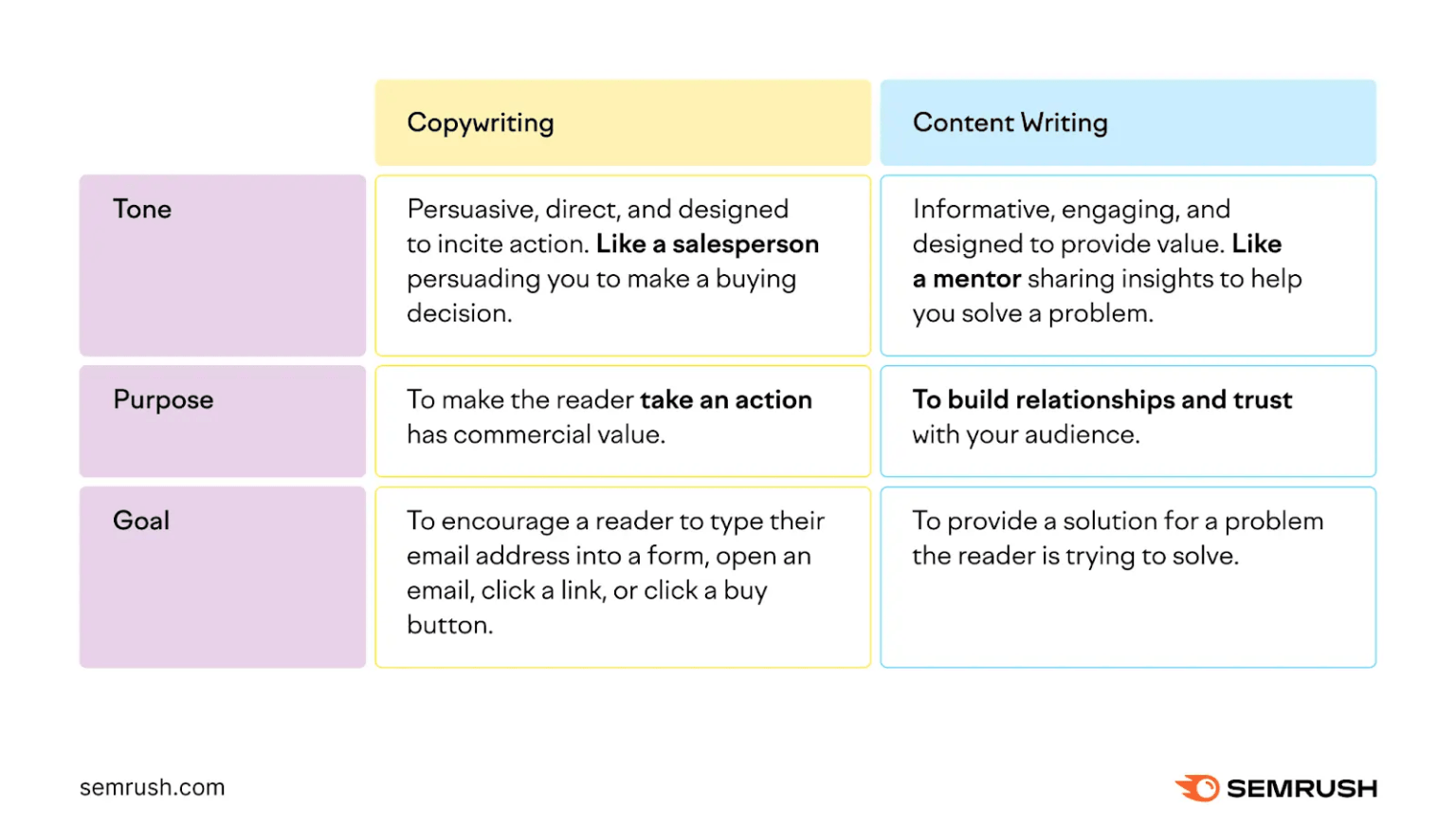
As a business or marketer, it’s crucial to recognize the synergy between copywriting and content writing and the importance of incorporating both into your digital marketing strategy.
While copywriting serves the purpose of driving immediate action and conversions, content writing provides valuable information, establishes trust, and nurtures long-term relationships with your audience.
By combining the persuasive power of copywriting with the engaging and informative nature of content writing, you can create a well-rounded and effective marketing approach.
Use cases for copywriting
Copywriting finds its place in various marketing materials and channels. Some common use cases for copywriting include:
- Ads: Creating attention-grabbing advertising headlines and taglines that capture the audience’s attention and create curiosity
- Landing pages or sales pages: Writing persuasive landing page copy that convinces visitors to take a specific action, such as making a purchase or filling out a form
- Sales collateral: Constructing effective sales emails, presentations, and more to drive conversions
- Social media posts: Composing impactful social media posts and ads that captivate audiences and encourage them to click, like, share, or make a purchase
Read: ‘10 social media content ideas for B2B businesses’
- Product descriptions: Crafting compelling product descriptions that highlight the unique features and benefits of a product
From social posts to sales pages, copywriting plays a fundamental role in delivering the intended message to potential customers, captivating them, and driving them to take action.
Use cases for content writing
While copywriting primarily focuses on immediate action, content writing serves a broader, longer-term purpose by delivering valuable information and engaging the audience on a deeper level. Some common use cases for content writing are:
- Blogs and articles: Creating informative and engaging blog posts and articles that educate readers on specific topics related to your industry or niche
- Website content: Developing compelling website content that showcases your products or services and communicates your brand’s story and values
- eBooks: Writing in-depth e-books that offer valuable insights, solutions, or guidance to your target audience, establishing your brand as an authority in the field
- White papers: Producing detailed research reports or white papers that delve into specific industry trends or challenges, demonstrating your expertise and thought leadership
- Infographics: Planning visually appealing infographics that present complex information or data in a digestible and shareable format
- Video or podcast scripts: Creating engaging and informative video or podcast scripts to deliver compelling narratives that are structured effectively, keeping the audience hooked throughout
Through content in these formats, businesses can demonstrate their expertise, build trust, and position themselves as thought leaders in their respective industries.
Use cases for content writing
Tone and Purpose:
- Copywriting: Persuasion and driving immediate action
- Content writing: Providing value, knowledge, and establishing trust
Focus:
- Copywriting: Direct response and conversions
- Content writing: Engaging audience and building relationships
Call-to-Action
- Copywriting: Immediate action
- Content writing: Building trust and loyalty
Style and Format
- Copywriting: Concise, attention-grabbing, persuasive
- Content writing: Informative comprehensive, and engaging
Conclusion
In conclusion, both copywriting and content writing are integral components of a successful digital marketing strategy. While copywriting aims to persuade and drive immediate action, content writing provides valuable information and engages the audience on a deeper level.
The key is to strike the right balance between the two to maximize the impact of your marketing efforts. That’s where professional content writing services can help you; with experienced writers, you can ensure that your brand delivers persuasive copy and valuable content that resonates with your target audience, ultimately leading to long-term success in the digital landscape. That’s where we come in—get in touch to discuss your content and design requirements with our experienced creative team!
FAQs on Copywriting vs. Content Writing:
1. What is the difference between copywriting and content writing?
A: Copywriting is focused on writing persuasive and compelling content that drives the reader to take action or make a purchase. Content writing, on the other hand, is focused on creating informative and educational materials that aim to engage and inform the reader.
2. How is copywriting different from content writing?
A: Copywriting is more directive, urging the reader to take a specific action, while content writing aims to indirectly influence or inform the reader. Copywriting requires a specific set of skills, such as creating compelling headlines, understanding the audience, and persuading readers to take action.
3. Why is copywriting necessary?
A: Copywriting is necessary to help businesses or individuals persuade their target audience to take a desired action, such as making a purchase, signing up for a service or downloading an app. It helps to create a strong brand identity and bring effective communication between customers and business.
4. Why is copywriting better than content writing?
A: Both copywriting and content writing have important roles in marketing. What copywriting does better than content writing is creating a sense of urgency or prompting the reader to take immediate action. It produces value to businesses by boosting sales, engagement rates and impacting customer attitudes towards brands/services.
Key References:
- What Is the Difference Between Copywriting vs Content writing? https://neilpatel.com/blog/copywriting-vs-content-writing/
- Copywriting vs. Content writing: Unveiling the Key Differences https://www.semrush.com/blog/copywriting-vs-content-writing/
- Freepik Image by pch.vector on Freepik